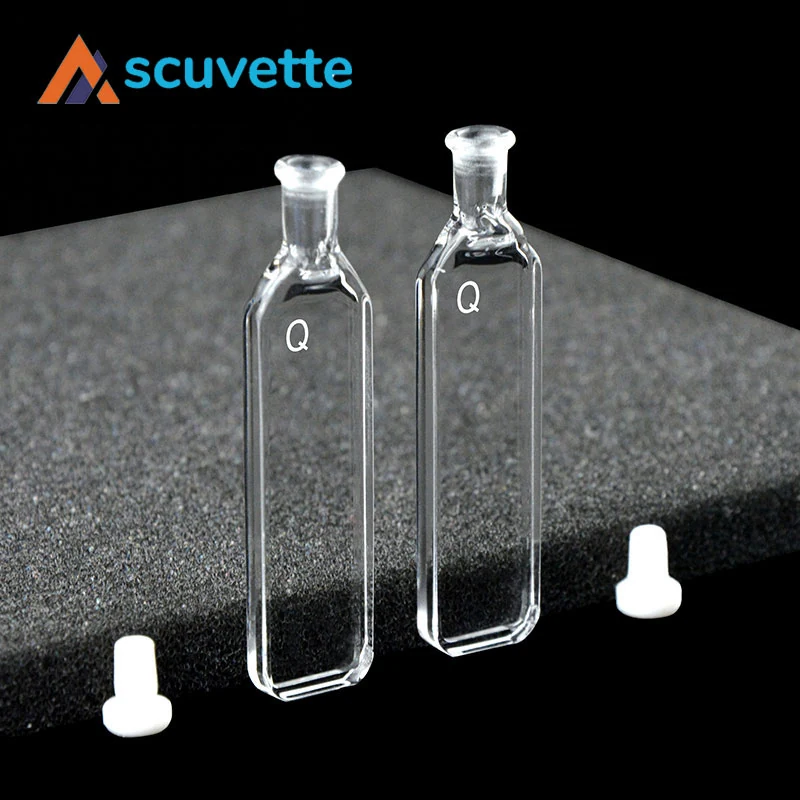
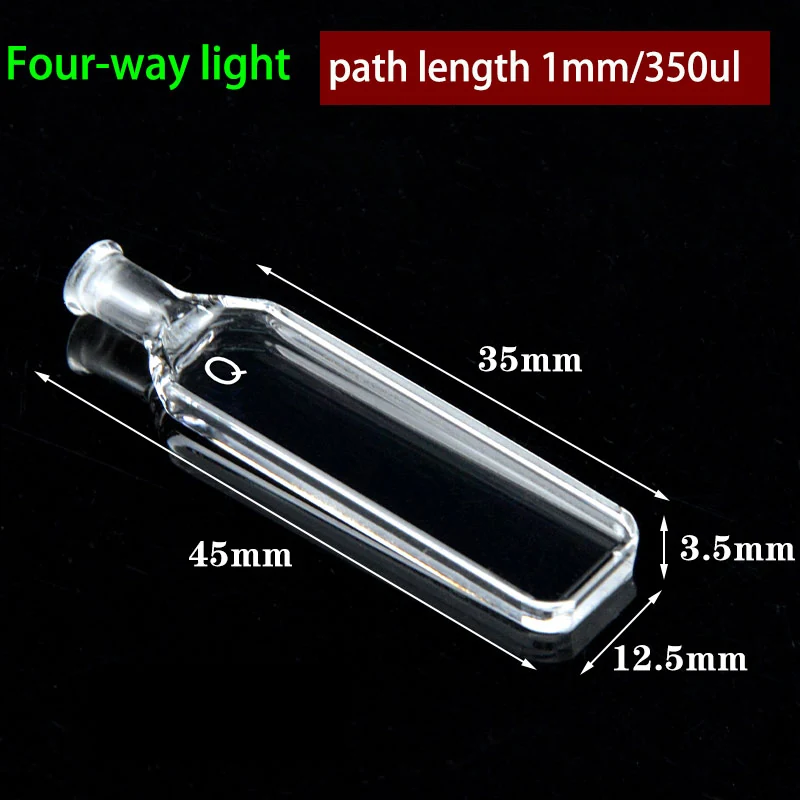
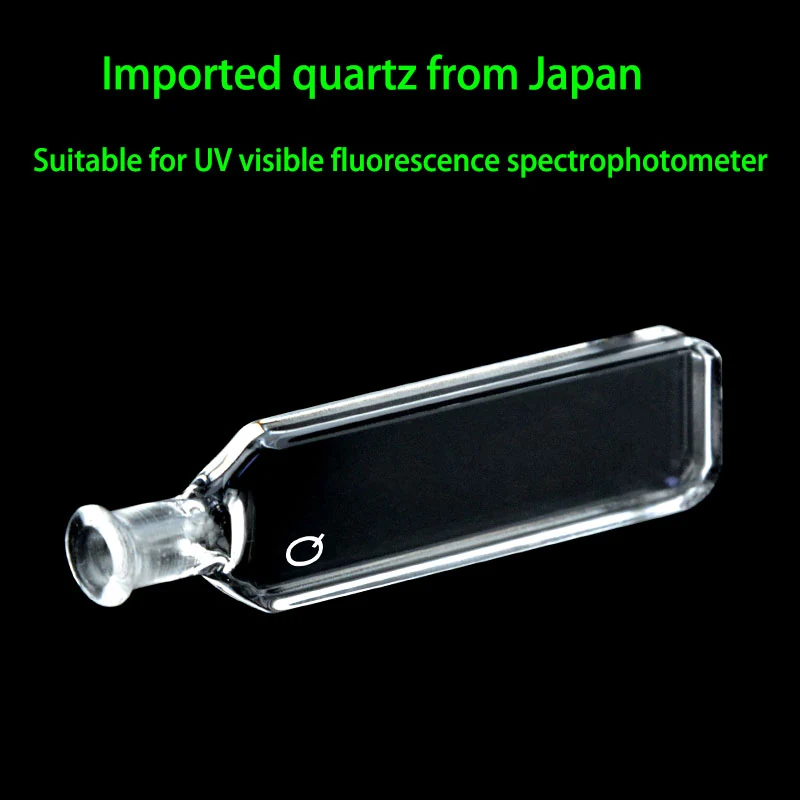
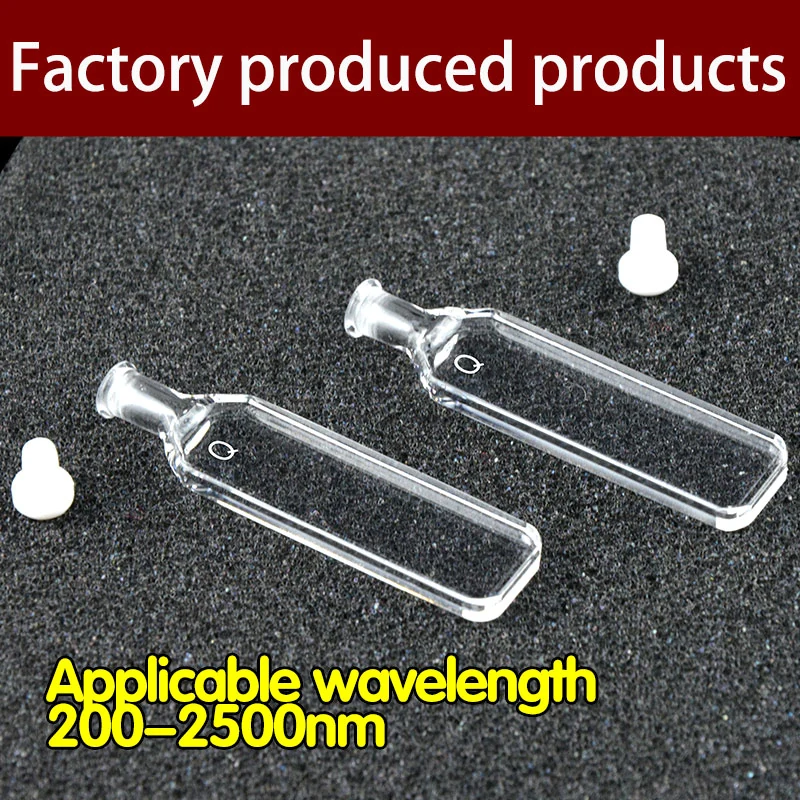
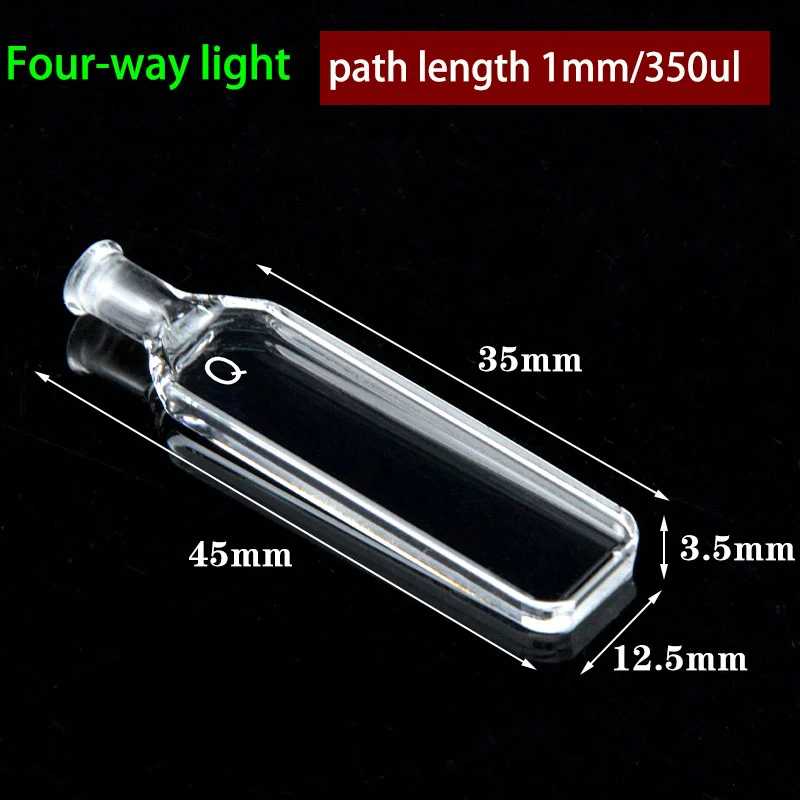
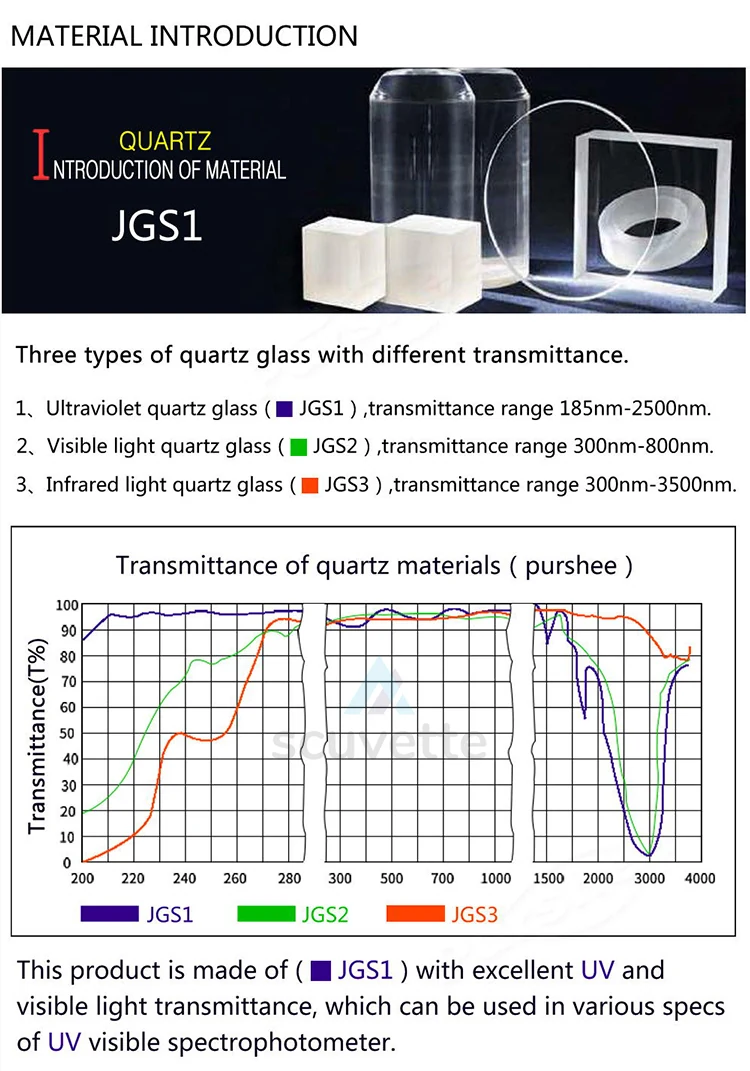
Brand: scuvette. 1mm quartz stoppered short path cuvette, four-way (four sides clear), 350μL volume. Japanese imported JGS1 fused silica, optical contact one-piece molding, >83% transmittance, 200nm-2500nm wavelength range, max operating temperature 1200°C. Outline dimension 12.5 × 3.5 × 45 mm, wall thickness 1.25mm. Supplied with PTFE stopper. Acid, alkali and organic solvent resistant.
4-Port or Two-Way? How to Choose
Both versions share the same 1 mm path length, 350 μL volume, JGS1 fused silica body and optical contact one-piece molding. The only difference is how many side walls are optically clear: the 4-Port cell is polished on all four walls, the Two-Way cell on two opposite walls only.
| | 4-Port (this page) | Two-Way |
|---|
| Clear faces | All four side walls | Two opposite walls |
|---|
| Best for | Setups where the cell orientation is not fixed, right-angle (90°) detection geometry, or one cell shared between instruments with different beam paths | Standard UV-Vis absorbance readings through a fixed beam path |
|---|
| Path length | 1 mm | 1 mm |
|---|
| Volume | 350 μL | 350 μL |
|---|
| Window material | JGS1 fused silica, 190–2500 nm | JGS1 fused silica, 190–2500 nm |
|---|
| Price | $175.00 | $138.00 |
|---|
If your spectrophotometer always reads through the same pair of faces, the Two-Way version does the same job at a lower price. Choose the 4-Port version when the cell may be rotated between measurements, when your method uses right-angle detection, or when several instruments share the same cell.
See the 1 mm Two-Way version of this stoppered short path cuvette →
01
Dimension Drawing & Specifications
02
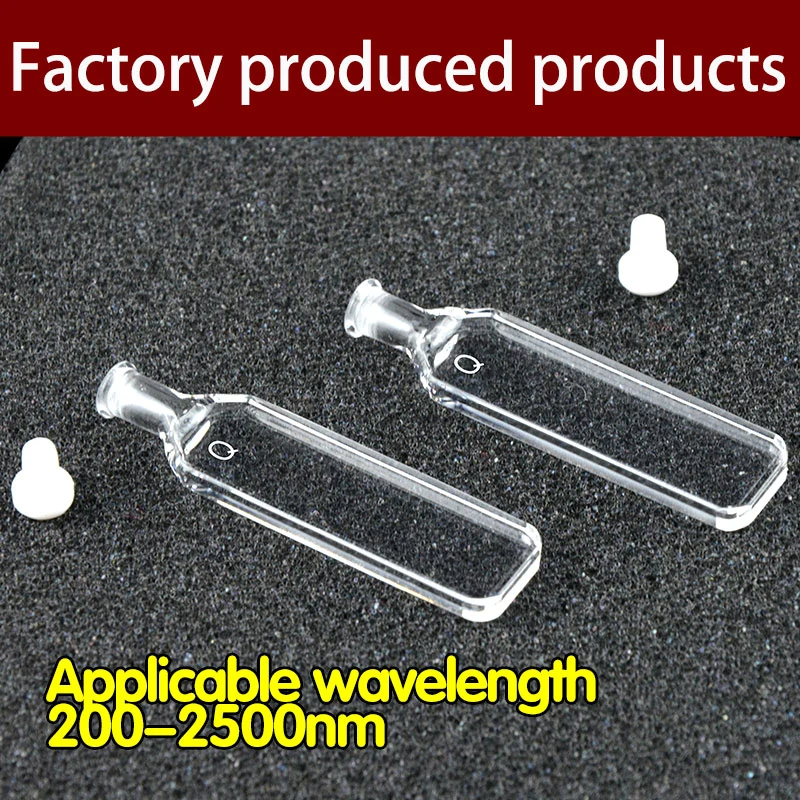
PTFE Stopper — Anti-Evaporation Sealing
03
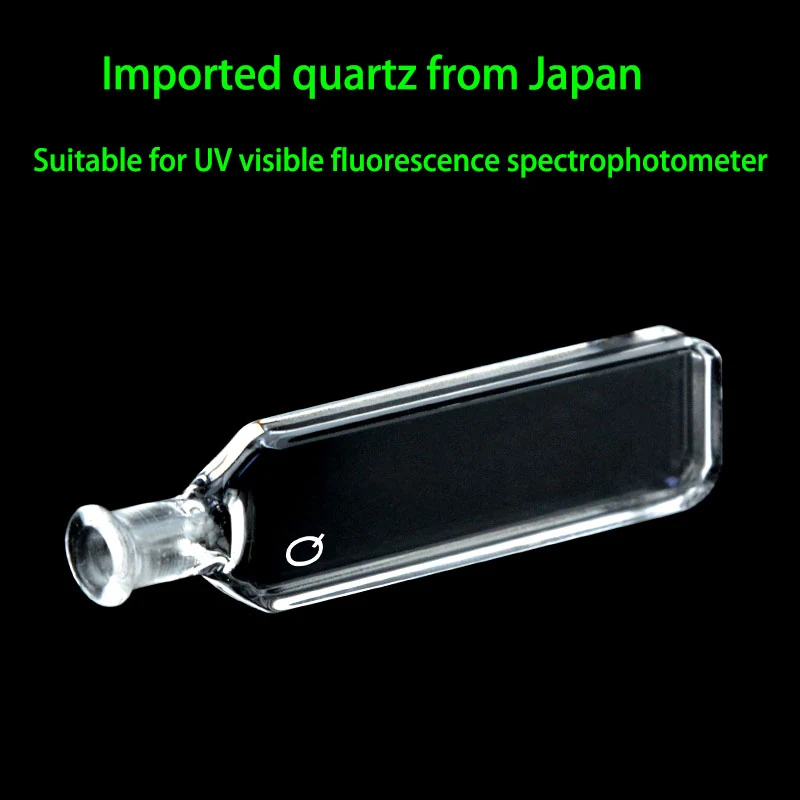
Optical Contact One-Piece Molding — JGS1 Fused Silica
04
Clear Windows for UV Spectrophotometer
05
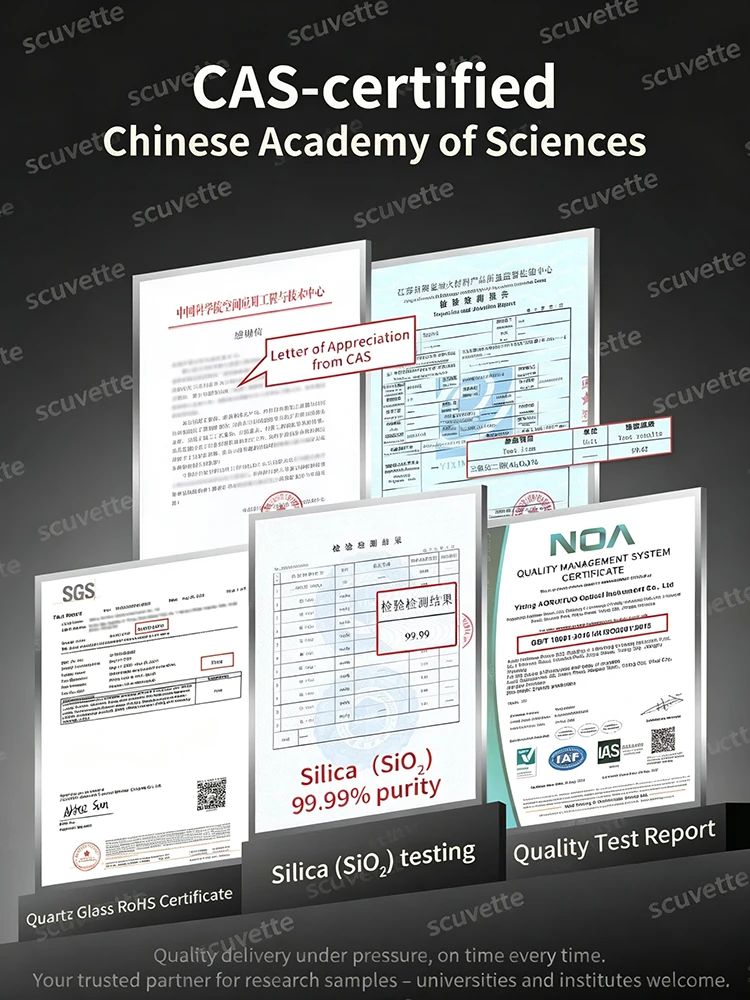
Quality Assurance & Packaging
4.9
★★★★★
Based on 26 verified reviews
RP
Raj P.
India · Verified Buyer
★★★★☆
Good product, the finish is clean and the windows are clear. Shipping took a bit longer than expected but the cuvettes themselves are worth the wait.
Reviewed on Jul 22, 2026
CW
Chen W.
Singapore · Verified Buyer
★★★★★
Excellent product. The optical contact process ones are comparable to German brands at a fraction of the cost. Our UV-Vis results are clean and reproducible.
Reviewed on Jul 2, 2026
SJ
Sarah J.
United States · Verified Buyer
★★★★★
Perfect for our UV-Vis applications. The quartz is clear, no bubbles or inclusions visible. Paired testing transmittance was within spec. Very satisfied.
Reviewed on Jul 5, 2026
JH
James H.
United Kingdom · Verified Buyer
★★★★☆
Good value cuvettes for routine lab work. The finish on the windows is clean and the dimensional accuracy is within tolerance. Would recommend for budget-conscious labs.
Reviewed on Jul 8, 2026
SM
Sophie M.
Germany · Verified Buyer
★★★★★
Sehr gute Verarbeitung und schnelle Lieferung. Die Küvetten passen genau in unsere Halterung und die Transmissionswerte stimmen. Sehr empfehlenswert.
Reviewed on Jun 18, 2026
1mm Quartz Stoppered Short Path Cuvette, 4-Port, 350µL – Frequently Asked Questions
What is the path length and sample volume of this cell?
Path length is 1 mm and the cell holds about 350 µL. A short path length keeps absorbance in the linear range for concentrated samples without diluting them.
Can I use strong acids, alkalis or organic solvents in it?
Yes. The body is Japanese JGS1 fused silica formed by optical contact one-piece molding, so there is no cemented seam to attack: the cell resists acids, alkalis and organic solvents. Only HF and hot phosphoric acid will etch quartz.
What temperature can the cuvette withstand?
Because it is a single piece of fused silica rather than an adhesive-bonded cell, the maximum operating temperature is 1200 °C. Remove the PTFE stopper before heating – it has a much lower limit.
Is a stopper included and what is it for?
Yes, a PTFE stopper is supplied with the cell. It closes the fill port so volatile samples do not evaporate during a run. Cleaning and handling guidance is in our cuvette care guide.